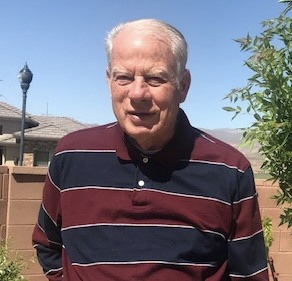
Dr. Mel Miles in the Back Yard of His Home in St. George, Utah, 2019
Summary of Dr. Miles’ LENR Career
Dr. Mel Miles was able to begin LENR experiments within a few days after he heard about the March 1989 announcement on the radio. He was at the time a senior chemist working at a U.S. Navy laboratory in California, where he had been doing electrochemistry experiments. Working initially on his personal time, he did not achieve excess heat in his LENR cells for many months but was ultimately successful.
His primary accomplishment while at the Navy lab was to demonstrate a correlation of the observed excess heat and the amount of helium generated in his electrochemical cells. This finding is considered one of the most important in the progression of LENR experiments to this day. He collaborated with Benjamin Bush at the The University of Texas at Austin, wherein Miles did the experiments and measured the heat generated. He then sent samples of the gas evolved to Bush, who measured the amount of helium generated. Using these data, Dr. Miles established the correlation of heat generation and helium production.
While still in his position at the Navy lab, Dr. Miles took a leave of absence and worked at the New Hydrogen Laboratory Lab in Sapporo, Japan for several months. He then left the lab and held positions at two universities, Middle Tennessee State University and Bates College in Maine, where he continued LENR research as he was able. Subsequently he was also at the University of Laverne in California for a time.
During the course of his LENR research career, Dr. M wrote or co-authored many reports and publications, mostly on venues of the LENR community, such as the Journal for Condensed Matter Nuclear Science. A comprehensive list of these items totals to more than 140. A unique component of Dr. Miles collections is a set of letters and other correspondence with Dr. Martin Fleischmann. These letters showed that Dr. Miles had an unusual ability to fully comprehend the full technical depth of Dr. Fleischmann’s understanding of LENR and electrochemistry.
An LRDI project, which included at least four visits Dr. Miles home in St. George, Utah, was conducted primarily in 2019. The project components consisted of lab notebooks, detailed notes of contacts and activities, published and unpublished reports, a large collection of LENR videos, and a library of books and related materials on the subject. Two interviews were recorded and transcribed during the site visits.
When Dr. miles died in October 2025, a visit was made to his home to collect and store his LENR research records. With the help of his spouse, Linda, the materials were placed in storage boxes and transported to a storage unit in Saint George. Efforts continue to have these materials placed as a LENR archive in the Special Collections of the University of Utah Marriott Library.
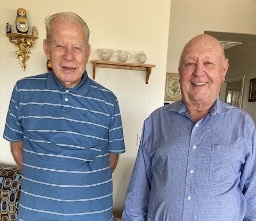
Dr. Miles and Dr. Grimshaw at Dr. Miles’ Home in St. George, UT, August 2021