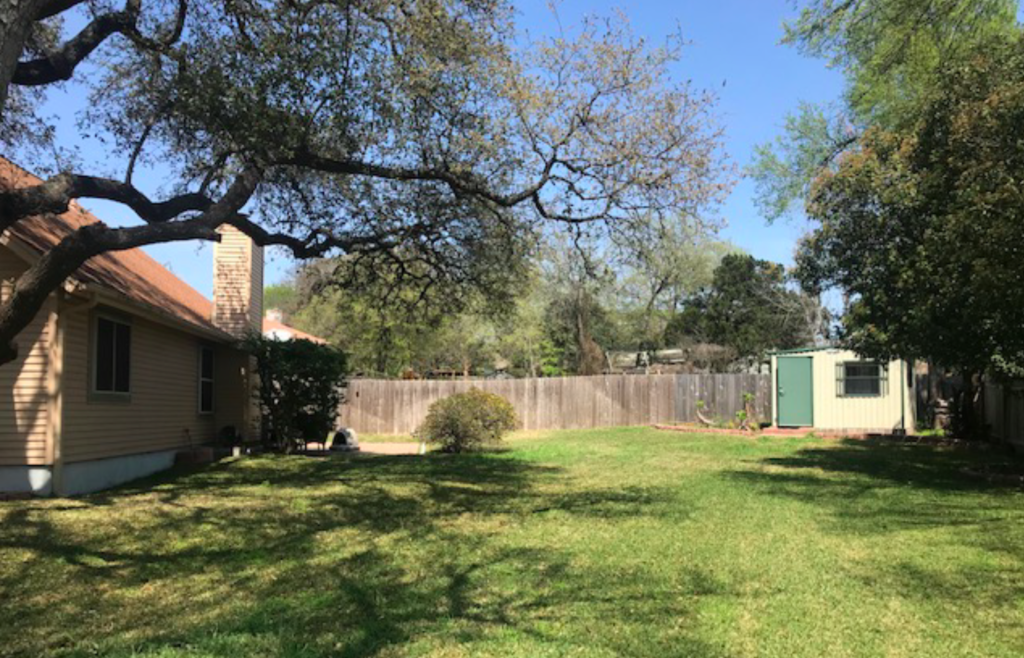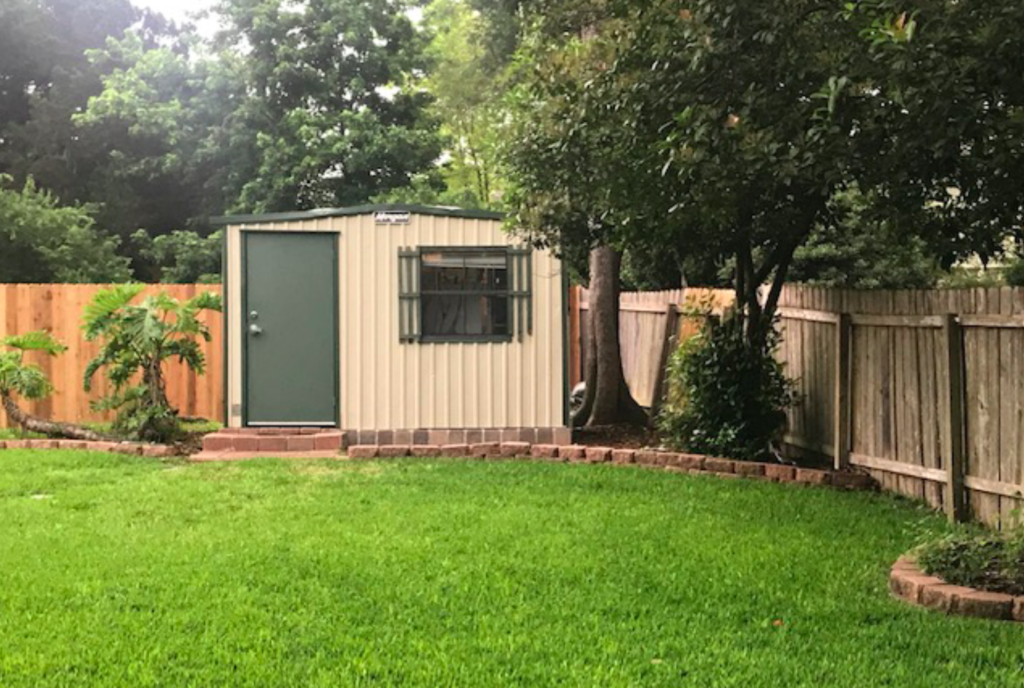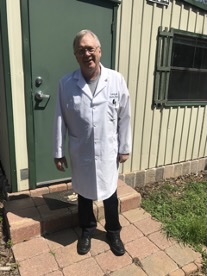
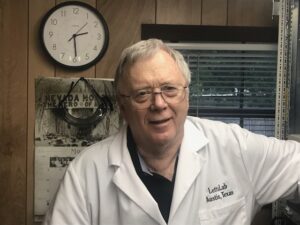
Dennis Letts in his LENR Research Lab (LettsLab), Austin, Texas. Photo Taken July 2019
Citation and Download for Letts LRDI Report
Shown below is a summary of Dennis Letts’ LRDI report as prepared by ChatGPT.
Executive Summary
Dennis Letts became involved in cold fusion soon after the 1989 announcement by Fleischmann and Pons. He began experimental LENR work in 1992 and continued for decades from his independent laboratory, LettsLab, in Austin, Texas. His work included radio-frequency stimulation, single- and dual-laser stimulation, codeposition, calorimetry, and gas-loading experiments. The report documents his publications, laboratory records, collaborations, interviews, and research chronology.
The most distinctive part of his research was his work with laser stimulation of palladium-deuterium systems. The report identifies an accidental single-laser observation in 2000, subsequent demonstrations and testing with other researchers, and the development of dual-laser experiments beginning in 2007.
Research Career
Letts studied early cold-fusion papers while engaged in gold mining in Bolivia. He returned to Austin to obtain papers from the University of Texas chemistry library and began developing his own experimental program. His formal LENR work began with RF stimulation of electrolytic cells in 1992, including collaboration with John Bockris.
In 2000 he observed an unexpected temperature increase when a low-power laser was directed at a deuterated palladium cell. This led to extensive single-laser experiments with Dennis Cravens and later to work involving Peter Hagelstein. After difficulty reproducing the single-laser effect with new palladium, Letts and Cravens began dual-laser experiments in 2007. Later work included codeposition, calorimetry, support for Francesco Celani demonstrations, and collaboration with Industrial Heat.
Research Locations
Most of Letts’ research was conducted in Austin, Texas. He worked initially in improvised home facilities and built LettsLab, a dedicated laboratory behind his home, in 1998.
Other important locations included John Bockris’s laboratory at Texas A&M University, an ENECO facility in Salt Lake City, SRI International in Menlo Park, California, and EarthTech International in Austin. Letts also demonstrated his work at major LENR conferences, including ICCF-10 in 2003.
Principal Collaborators
John Bockris was an early collaborator and co-author. Dennis Cravens became Letts’ principal long-term experimental collaborator, particularly in laser and codeposition research. Peter Hagelstein provided important theoretical guidance and later collaborated on dual-laser experiments.
Other significant connections included Michael McKubre and Fran Tanzella at SRI International; Scott and Marissa Little and colleagues at EarthTech International; Francesco Celani and National Instruments; and Industrial Heat.
Publications, Presentations and Reports
Volume 1 lists more than 30 publicly available publications, presentations, and related works. The record begins with Letts’ 1993 paper with John Bockris on triggering heat and subsurface changes in palladium-deuterium systems.
Later publications document laser stimulation, cathode fabrication, optical-phonon stimulation, dual-laser experiments, codeposition, calorimetry, and methods for calculating excess power. The report notes publications and presentations at ICCF conferences, the Journal of Condensed Matter Nuclear Science, Infinite Energy, Current Science, and other venues. Copies of the publicly available works are assembled in Volume 2.
Interviews
Two sets of interviews were conducted with Letts in 2019. The first took place in March and the second in July. Together they provide a first-person account of his entry into LENR, his early RF work, the discovery of laser stimulation, his collaborations, the EarthTech and SRI activities, the transition to dual lasers, and later research.
The interview transcripts are included in Volume 1 and are an important oral-history component of the LRDI record.
Materials in the LRDI Archive
The Letts documentation includes approximately 11 or 12 hard-copy laboratory notebooks, electronic research records, publications and presentations, books and conference proceedings, photographs, interview recordings and transcripts, research memoranda, and laboratory equipment information.
A particularly important item is the oversized March 2002 notebook, “Laser Stimulation of Deuterated Palladium,” associated with an experiment at SRI involving sample #565. An accompanying electronic spreadsheet was also included in the project.
The report also provides a detailed inventory of LettsLab equipment, including RF equipment, power supplies, oscilloscopes, spectrum analyzers, data loggers, calorimetric equipment, computers, and other laboratory instruments.
Historical Significance
The Letts Volume 1 report is historically important because it documents a long-running independent LENR research program beginning in the early 1990s. It preserves the development of experimental methods and the relationships between an independent researcher and academic, laboratory, commercial, and other LENR investigators.
The laser-stimulation work is especially significant to the historical record. The report traces the progression from the 2000 single-laser observation through demonstrations and evaluation by other researchers and the subsequent dual-laser program beginning in 2007.
The combination of publications, laboratory records, equipment information, photographs, and first-person interviews makes the Letts collection a valuable primary-source record for the history of LENR research.
==========
Three Views of Dennis Letts’ Backyard LENR Laboratory (LettsLab) in Austin, Texas.
Photos Taken March and July 2019.